Political parties speak of democracy, but internal disputes often reveal a very different operating system.
Most coverage of this subject begins with the loudest event. The more useful question is what sits underneath it, who benefits from the dominant explanation and what ordinary people may not be seeing.
Political parties present themselves as institutions of public purpose. Yet when a party splits, the fight can quickly become a battle over names, symbols, offices, inheritance and personal authority.
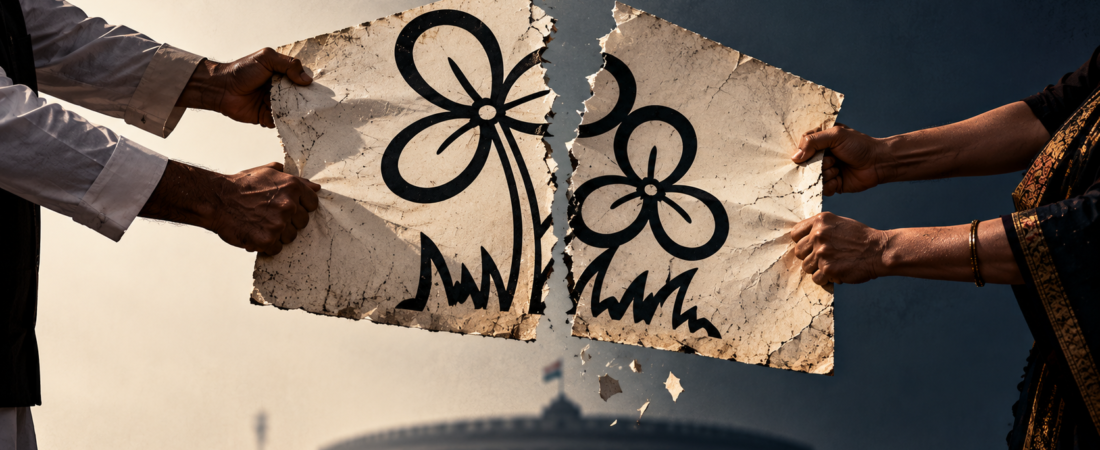
Reporting on the dispute involving the Trinamool Congress and the Election Commission shows how a party identity can become legally and emotionally contested. A symbol is not just ink on a ballot. It carries memory, recognition and the accumulated labour of workers and voters.
The deeper question is institutional. Who owns a political party? The founder, the elected representatives, the cadre, the voters or the constitution under which the party is registered? In practice, the answer can become a messy mixture of all five.
Personality-driven politics makes parties easier to market but harder to democratise. A leader can become the face, voice and emotional centre of an organisation, which creates energy during elections but fragility during succession.
Voters are often asked to treat parties as stable brands even when their internal structures are cracking. Perhaps the public deserves more transparency about internal elections, funding, decision-making and accountability. If a party demands democratic legitimacy from the country, should it not practise more of it inside its own walls?
The point is not to manufacture certainty. It is to leave room for evidence, competing explanations and the possibility that the first version of the story is incomplete.
Questions worth carrying with you
- Should party symbols belong to organisations or be treated as political inheritance?
- What should happen when a leader and a party’s institutional machinery separate?
- Can personality-led parties survive without weakening internal democracy?
Suggested internal links
- Link to “The Voter List Is Not Clerical Paperwork” with a natural anchor in the body or closing section.
- Link to “Satire, Arrests and the Thin Skin of Power” with a natural anchor in the body or closing section.
Social-media adaptations
- Instagram/Facebook: Political parties speak of democracy, but internal disputes often reveal a very different operating system. Read the full analysis on Baal Ki Khaal. We are not here to stop at the headline. #BaalKiKhaal #ContextMatters
- LinkedIn: When Party Symbols Become Family Property. The important question is not only what happened, but how incentives, institutions and public perception shape the story.
- X: When Party Symbols Become Family Property. The headline is only the entrance. The real story is in the context, incentives and consequences. What are we missing?
- Short-video hook: “Everyone is discussing when party symbols become family property. But what if the most important part is what nobody is discussing?”