
A democracy that cannot tolerate mockery is asking for applause, not accountability.
Most coverage of this subject begins with the loudest event. The more useful question is what sits underneath it, who benefits from the dominant explanation and what ordinary people may not be seeing.
Political satire has always been dangerous because it turns authority into something ordinary. A powerful person can survive criticism more easily than ridicule, because ridicule removes the distance that power depends on.
Recent reporting around a comedian’s political mimicry and cancelled shows has revived questions about threats, pressure and the shrinking comfort zone for satire. The facts of each incident must be verified carefully, but the larger debate is familiar: when does offence become a justification for intimidation?
Not every joke is wise. Not every comedian is fair. Satire can be cruel, lazy or prejudiced. The answer to bad comedy, however, should not automatically be threats, censorship or the use of state power. A free society needs room for criticism, including criticism that is clumsy.
The same people who demand respect for their leaders often enjoy mockery when it is directed at their opponents. That is not principle. That is fandom wearing a kurta.
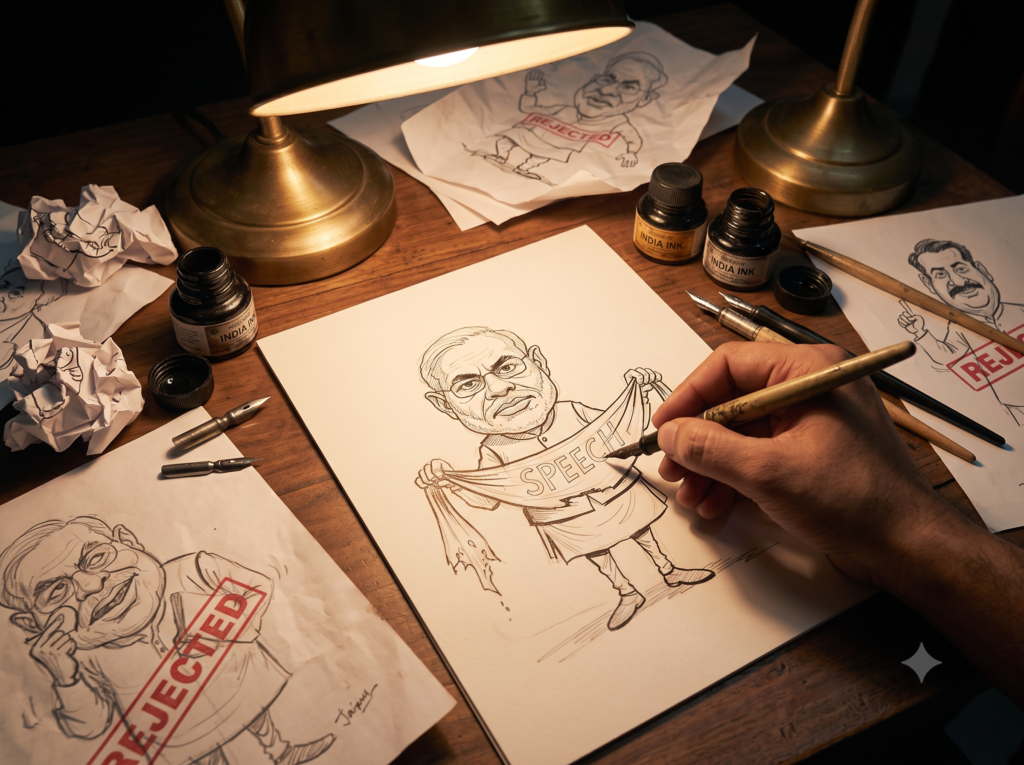
Power must learn to absorb embarrassment. Citizens must learn to distinguish between a bad joke and a genuine threat. And institutions must resist becoming the private security detail of wounded egos.
The point is not to manufacture certainty. It is to leave room for evidence, competing explanations and the possibility that the first version of the story is incomplete.
Questions worth carrying with you
- Who gets to decide when satire crosses a legal line?
- Would we defend the same joke if it targeted the leader we support?
- Can public figures demand dignity without demanding immunity from mockery?
Suggested internal links
- Link to “The Voter List Is Not Clerical Paperwork” with a natural anchor in the body or closing section.
- Link to “When Party Symbols Become Family Property” with a natural anchor in the body or closing section.
Social-media adaptations
- Instagram/Facebook: A democracy that cannot tolerate mockery is asking for applause, not accountability. Read the full analysis on Baal Ki Khaal. We are not here to stop at the headline. #BaalKiKhaal #ContextMatters
- LinkedIn: Satire, Arrests and the Thin Skin of Power. The important question is not only what happened, but how incentives, institutions and public perception shape the story.
- X: Satire, Arrests and the Thin Skin of Power. The headline is only the entrance. The real story is in the context, incentives and consequences. What are we missing?
- Short-video hook: “Everyone is discussing satire, arrests and the thin skin of power. But what if the most important part is what nobody is discussing?”