
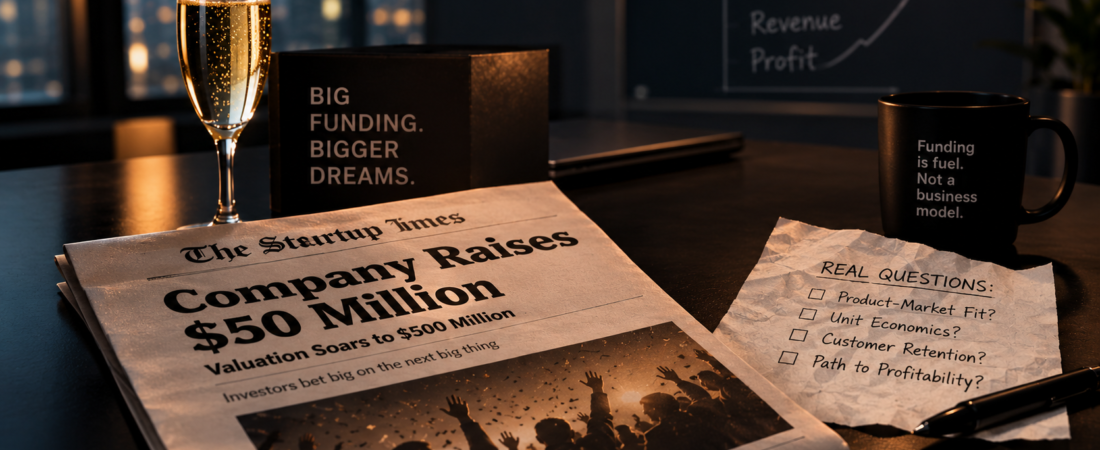
A funding announcement is a headline. It is not proof that a company has found product-market fit.
Most coverage of this subject begins with the loudest event. The more useful question is what sits underneath it, who benefits from the dominant explanation and what ordinary people may not be seeing.
Startup culture has trained us to celebrate funding rounds as if capital itself were a business achievement. A company raises money, a valuation appears, investors smile for photographs and the internet declares that the future has arrived.
Capital matters. It buys time, talent, distribution and experimentation. But it can also disguise unresolved questions. Who pays? Why do they stay? What does it cost to serve them? Can the company grow without permanently subsidising demand?
India’s startup ecosystem continues to produce ambitious companies across AI, fintech, climate, space, commerce and consumer products. The interesting stories are not only the biggest cheques. They are the companies learning to survive after the investor presentation ends.
Founders are often told to move fast, break things and capture markets. Customers, employees and regulators are left to clean up the broken glass. A more mature startup culture should reward responsible speed, clear economics and the ability to admit when an assumption was wrong.

Funding is fuel, not direction. A well-funded company can still be driving into a wall with excellent branding and a very confident LinkedIn post.
The point is not to manufacture certainty. It is to leave room for evidence, competing explanations and the possibility that the first version of the story is incomplete.
Questions worth carrying with you
- Should valuations be discussed without revenue, retention and unit economics?
- When does growth become a way of postponing hard decisions?
- What would a healthier definition of startup success look like?
Suggested internal links
- Link to “Quick Commerce and the Price of Convenience” with a natural anchor in the body or closing section.
- Link to “Celebrity Investors and the Business of Borrowed Trust” with a natural anchor in the body or closing section.
Social-media adaptations
- Instagram/Facebook: A funding announcement is a headline. It is not proof that a company has found product-market fit. Read the full analysis on Baal Ki Khaal. We are not here to stop at the headline. #BaalKiKhaal #ContextMatters
- LinkedIn: The Startup Funding Party Is Not the Business Model. The important question is not only what happened, but how incentives, institutions and public perception shape the story.
- X: The Startup Funding Party Is Not the Business Model. The headline is only the entrance. The real story is in the context, incentives and consequences. What are we missing?
- Short-video hook: “Everyone is discussing the startup funding party is not the business model. But what if the most important part is what nobody is discussing?”