
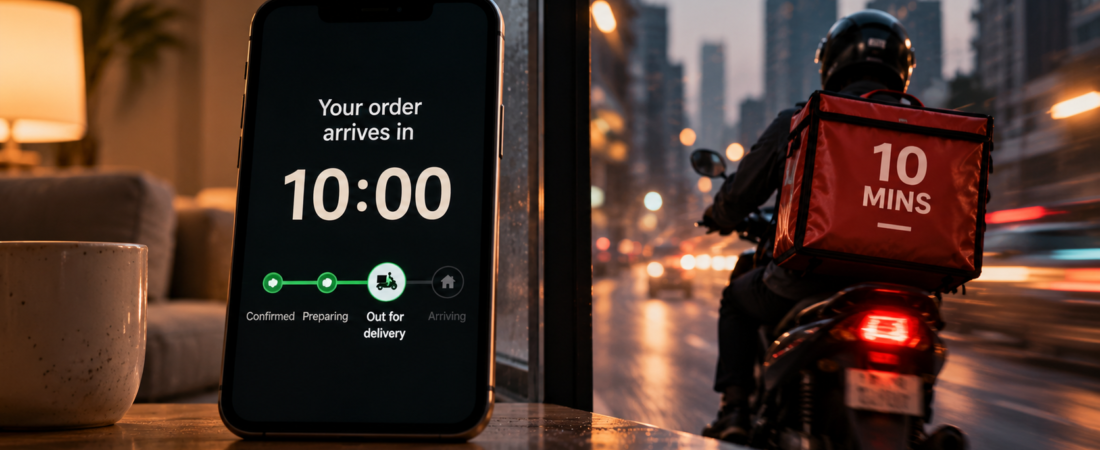
The ten-minute delivery promise raises a bigger question: who pays for our impatience?
Most coverage of this subject begins with the loudest event. The more useful question is what sits underneath it, who benefits from the dominant explanation and what ordinary people may not be seeing.
Quick commerce has turned convenience into a competitive sport. Groceries, snacks, cosmetics and household essentials arrive before the customer has had time to regret the order.
The model is impressive when viewed through logistics, warehousing and software. It is more complicated when viewed through profitability, worker safety, local retail competition and consumer psychology.
Companies are racing to expand, especially around major festive shopping periods. The temptation is obvious: if speed becomes habit, the platform becomes part of daily life. But habit is not the same as sustainable economics.
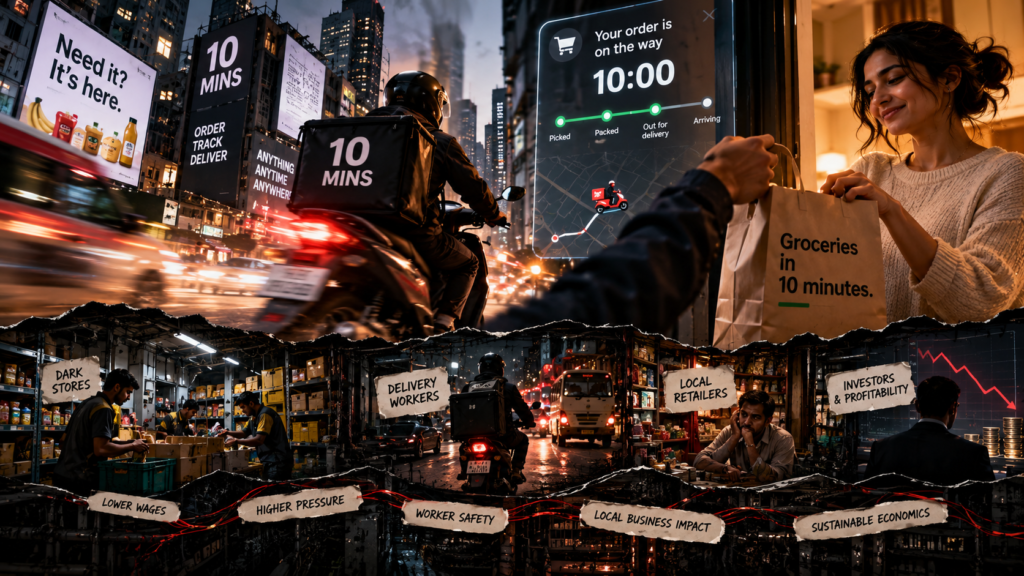
Every order has hidden participants. There is the picker inside the dark store, the delivery worker navigating traffic, the small retailer losing a customer and the investor waiting for a path to profit. The consumer sees a timer. The system contains an entire labour and capital structure.
Convenience is not inherently bad. Neither is ambition. But a society should be able to ask whether every small delay must be treated as a problem requiring venture capital to solve.
The point is not to manufacture certainty. It is to leave room for evidence, competing explanations and the possibility that the first version of the story is incomplete.
Questions worth carrying with you
- Is ten-minute delivery a genuine need or a manufactured expectation?
- What protections should delivery workers receive as speed becomes the product?
- Can quick commerce become profitable without transferring too much cost to society?
Suggested internal links
- Link to “The Startup Funding Party Is Not the Business Model” with a natural anchor in the body or closing section.
- Link to “Celebrity Investors and the Business of Borrowed Trust” with a natural anchor in the body or closing section.
Social-media adaptations
- Instagram/Facebook: The ten-minute delivery promise raises a bigger question: who pays for our impatience? Read the full analysis on Baal Ki Khaal. We are not here to stop at the headline. #BaalKiKhaal #ContextMatters
- LinkedIn: Quick Commerce and the Price of Convenience. The important question is not only what happened, but how incentives, institutions and public perception shape the story.
- X: Quick Commerce and the Price of Convenience. The headline is only the entrance. The real story is in the context, incentives and consequences. What are we missing?
- Short-video hook: “Everyone is discussing quick commerce and the price of convenience. But what if the most important part is what nobody is discussing?”